
Share this story
IG Story is the most common format. We'll generate a branded image sized for your pick.
This story uses a landscape banner, so IG Story may show small borders above and below the image.
What Helps Wrestlers Jump Levels?
In one of the toughest wrestling states in the country, Pennsylvania wrestler AJ Schopp finished fifth in the state as an eighth grader in the PJW's (junior division). That is a strong accomplishment in its own right, but one year later, as just a freshman competing against older high school wrestlers, he finished second. When asked what had changed, Schopp pointed to a summer spent attending nine weeks of wrestling camps and training multiple times a day, nearly every day. He eventually went on to win a Pennsylvania state championship, earn a scholarship to Edinboro University, become a four-time NCAA qualifier, and a three-time All-American.
Stories like this are common in wrestling. A wrestler who appeared to be developing at a steady pace suddenly breaks through. The athlete who struggled to score consistently begins finishing shots. The wrestler who faded late in matches starts winning difficult third periods. The wrestling community has a phrase for it: “jumping levels.”
The term is common, but it raises an important question: What actually causes these developmental breakthroughs? Are the factors that contribute to long-term wrestling success the same factors that help athletes improve rapidly, or is accelerated development driven by something different?
That question became the foundation of the JUMPS Assessment, which stands for Jumping Levels: Understanding and Measuring Performance Enhancement and Speed of Improvement. The project asked athletes, parents, and coaches what they believe contributes to wrestling success and compared those perceptions to the factors they believe accelerate improvement. Participants evaluated developmental factors and answered open-ended questions about enjoyment, performance, accelerated improvement, barriers, and the experiences they believed contributed most to rapid growth.
What the Numbers Tell Us
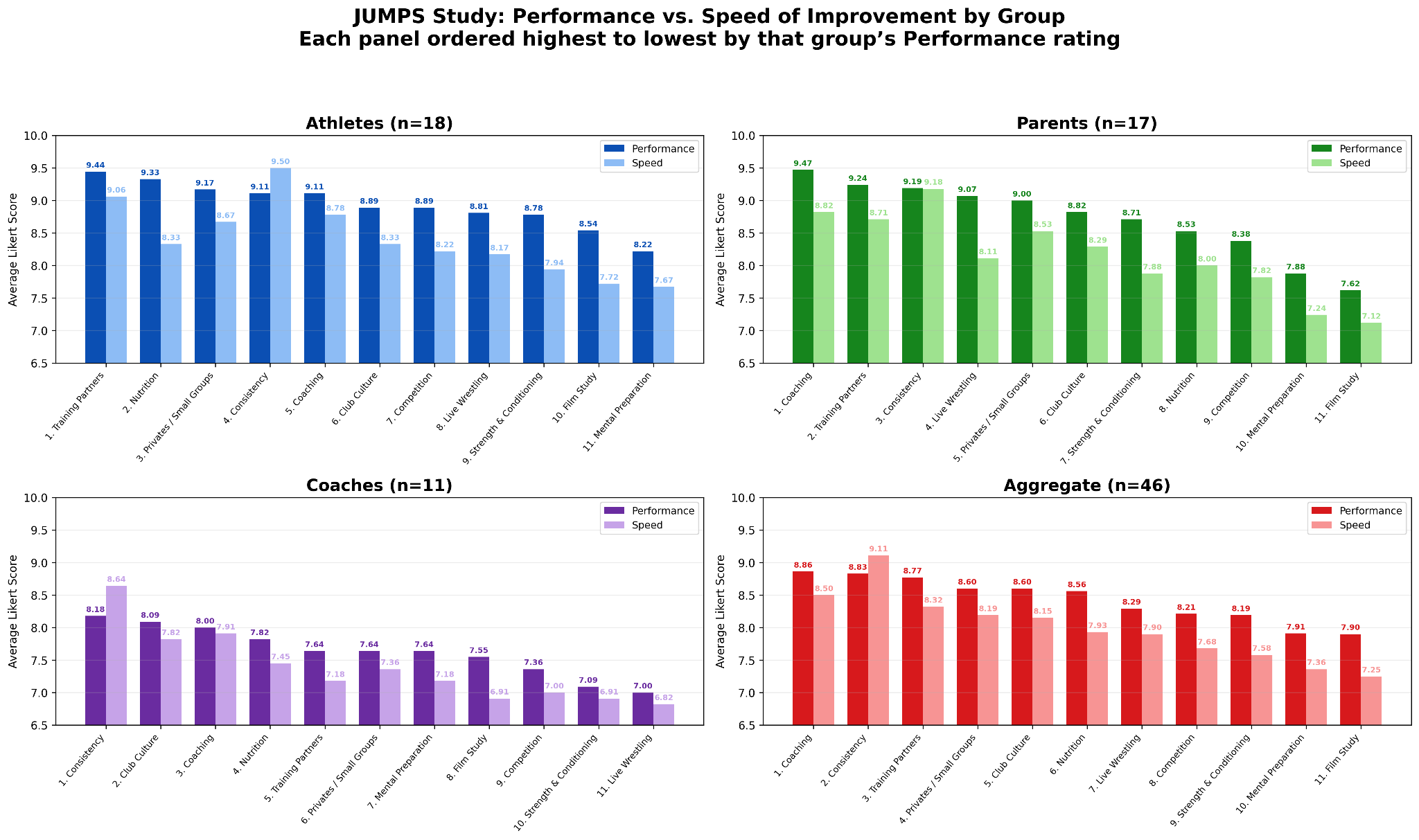
The quantitative results showed that many of the same factors associated with long-term wrestling success were also associated with accelerated improvement. Across athletes, parents, and coaches, respondents generally viewed performance and speed of improvement as closely related concepts rather than entirely separate developmental pathways.
The more interesting distinction emerged in the open-ended responses. When participants discussed performance gains, they referenced a broad collection of influences, including competition, nutrition, strength training, film study, mental preparation, coaching, training partners, and club culture. When they discussed rapid improvement, however, their attention narrowed considerably. Again and again, athletes, parents, and coaches returned to the same handful of developmental accelerators: quality coaching, quality training partners, consistency, individualized instruction, and strong developmental environments.
In other words, respondents viewed wrestling success as the product of many contributing factors, but they viewed rapid improvement as being driven by a smaller and more focused set of developmental experiences.
Consistency Is Key
One of the more interesting findings was that consistency was the only factor in the aggregate ratings where speed of improvement slightly exceeded performance. It suggests that respondents viewed consistency not simply as something that contributes to success, but as something that may actively accelerate development by allowing the other factors to compound.
Athletes talked about constant training and frequent competition. Parents described school practices layered on top of club practices and repeated exposure to challenging opponents. Coaches emphasized consistency almost relentlessly. One coach summarized the idea in three words: “Consistency is king. Period.” Another wrote, “Frequency is king when it comes to developing athletes.”
Those comments were not isolated. They reflected a broader pattern throughout the responses. Great coaching only helps if athletes consistently show up. Strong training partners only matter if athletes consistently train with them. A strong club environment only matters if athletes consistently participate in it. Even private lessons appear to create their greatest value when athletes consistently attend them and apply what they learn.
Consistency is king. Period. Give me 5-6 days a week of structured/injury free training, and we can expedite performance improvements.
This may help explain why developmental breakthroughs often seem to happen quickly. A parent, coach, or teammate who has not seen a wrestler in several months may suddenly notice a dramatic difference in performance. In reality, the breakthrough is rarely immediate. The visible jump is often the result of months of consistent training, quality feedback, competition, recovery, and adjustment quietly accumulating beneath the surface until the improvement can no longer be missed.
The Power of Training Partners
Another factor that emerged repeatedly throughout the study was the importance of training partners. Across athletes, parents, and coaches, the importance of quality training partners surfaced repeatedly. Whether discussing enjoyment, performance gains, or rapid improvement, respondents consistently pointed to the value of having strong partners in the room.
One athlete wrote, “I enjoy the high level practice partners the most because that's where I feel I make the most growth.” Another pointed simply to “the amount of high level partners in the wrestling room.” Others described the value of getting different looks from different high-level wrestlers and learning how to solve problems against a variety of styles.
I enjoy the high level practice partners the most because that's where I feel I make the most growth.
Parents echoed this sentiment. One parent explained that practicing with higher-level wrestlers consistently pushed their athlete to improve. Another described training with top talent and traveling to compete against the nation's best as one of the most beneficial developmental experiences available. A third parent wrote that exposure to high-caliber training partners challenged decision-making and rapidly developed sports IQ and situational awareness.
Coaches were equally emphatic about the importance of training partners. In fact, many identified quality partners as one of the most powerful accelerators of development in the entire study. Where coaches added insight was not in whether training partners mattered, but in what makes a training partner valuable. Several pointed out that a high-level wrestler is not automatically a great practice partner. One coach observed that a dedicated mid-level partner who provides accountability, effort, and quality looks may contribute more to development than a talented wrestler who simply goes through the motions. Another noted that some athletes who have jumped levels fail to provide quality looks to others, limiting the developmental value they bring to the room.
The message was remarkably consistent across all three groups. Athletes improve fastest when they are surrounded by training partners who challenge them, expose weaknesses, provide feedback, and create accountability every day.
Coaching and the Power of Individualized Development
Another major theme involved coaching, particularly individualized coaching. Athletes repeatedly referenced private lessons, small-group instruction, and high-quality coaches. One athlete identified “high quality coaches in small groups” as the factor that helped him jump levels. Another pointed to “working with high quality coaches in small groups.”
Parents often described coaching in terms of direct feedback and mentorship. One parent explained that small-group instruction allowed technical flaws to be diagnosed and corrected immediately while engagement, confidence, and wrestling IQ increased rapidly. Another described private and small-group training as a high-accountability environment where an athlete can fail, adjust, and learn without the pressure of a large crowd.
Coaches agreed and often reinforced what athletes and parents were already describing. Several emphasized the importance of individualized instruction and adapting coaching to the needs of the athlete. One coach warned against “cookie cutter” coaching, while another highlighted the value of tailoring drills and techniques to an athlete's style, strengths, and developmental needs. One coach answered, “I say private lessons, because it allows athletes to get one on one time to work on their craft.”
Taken together, the responses suggest that coaching is about much more than showing moves. Great coaching creates an environment where learning becomes more efficient because feedback is targeted to the athlete's most immediate developmental needs.
I say private lessons, because it allows athletes to get one on one time to work on their craft.
Live Wrestling
Few topics generated as much discussion as live wrestling. Athletes loved it. They wrote “live during practice,” “live go's,” and “I enjoy live wrestling the most.” One athlete offered perhaps the most memorable explanation in the entire study: “Wrestling is half feel and half technique and you get that feel wrestling with good kids live.”
Wrestling is half feel and half technique and you get that feel wrestling with good kids live.
Parents echoed the same general idea. Many viewed live wrestling as motivating and valuable because it exposes athletes to pressure, resistance, and different styles. For athletes especially, live wrestling is where wrestling feels most real. It is where technique meets reaction.
The coaches, however, introduced one of the most sophisticated insights in the study. Several argued that not all live wrestling produces the same developmental outcomes. One coach described “high IQ play wrestling” as the most valuable version of live wrestling, explaining that athletes continue solving positional problems rather than focusing exclusively on winning exchanges. Another coach described situational live wrestling as the place where self-correcting habits are formed. Others cautioned that poorly controlled live wrestling can increase injury risk and reduce the consistency that ultimately drives development.
The coaches were not dismissing live wrestling. They were refining it. Their responses suggest that live wrestling is most valuable when it functions as a learning exercise rather than simply a way to determine who wins and loses. In that sense, developmental live wrestling may be the bridge between drilling and competition, allowing wrestlers to build feel, creativity, and problem-solving ability under realistic pressure.
What the Assessment Missed
The final question asked participants to identify factors that had helped improve or accelerate performance but were not included in the survey. Their responses revealed several themes that may help explain why some athletes improve more rapidly than others.
Athletes frequently mentioned camps, open mats, extra practice opportunities, online instructional content, curiosity, and a willingness to ask questions. Parents highlighted mentorship, recovery, exposure to different coaching styles, and training with a variety of partners and programs. Coaches expanded the conversation even further. While many reinforced the importance of coaching, training partners, and developmental environments, several pointed to factors that were not directly measured by the assessment. Personal drive, accountability, leadership, discipline, recovery, spirituality, goal setting, and self-preparation appeared repeatedly throughout their responses.
Personal drive is the only factor I would give a 10/10.
Collectively, they suggest that accelerated development may be influenced not only by coaching, training partners, and competition, but also by personal character and the choices athletes make when nobody is directing them.
Key Takeaways
Taken together, the findings from the JUMPS Assessment paint a remarkably consistent picture of how wrestlers improve and, perhaps more importantly, how they improve rapidly. Rather than pointing to different developmental pathways, athletes, parents, and coaches repeatedly emphasized the same core factors: consistency, quality training partners, high-quality coaching, individualized instruction, strong developmental environments, and challenging competition.
The findings suggest that rapid improvement occurs when multiple developmental advantages begin working together and compounding over time. Coaching builds skill, training partners provide challenge, consistency creates repetition, and competition exposes weaknesses. Individually, each contributes to development. Together, they create a developmental system whose effects become progressively more powerful over time.
The wrestling community often talks about athletes who suddenly “jump levels,” but the findings from this study suggest those jumps are rarely sudden at all. More often, they are the visible result of countless practices, thousands of repetitions, meaningful feedback, strong coaching, challenging partners, and a developmental environment that consistently pushes athletes beyond their comfort zones. Long before anyone recognizes the breakthrough, its foundation has already been built. The jump-level moment is simply the point at which months, and sometimes years, of accumulated growth finally become impossible to miss.